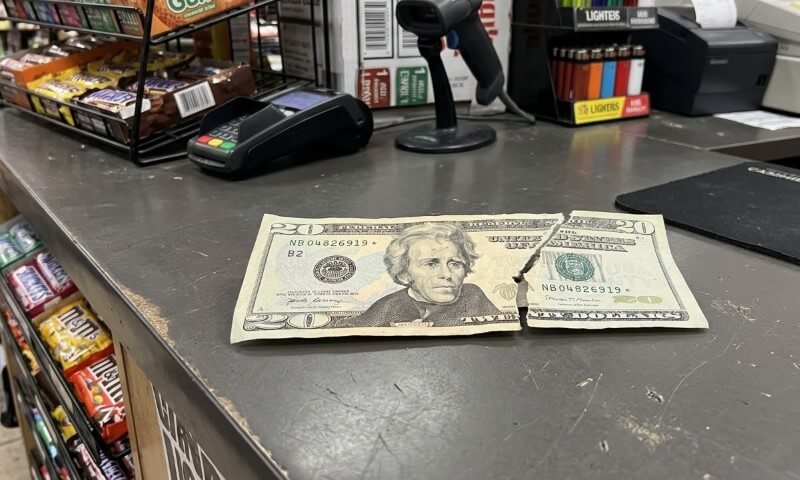
A $20 bill looks perfectly ordinary, apart from a tear running halfway across one corner.
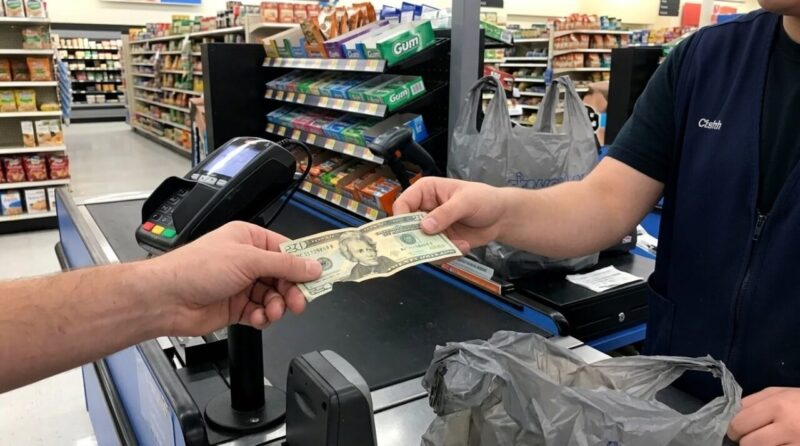
You hand it to the cashier to pay for $12 worth of groceries. After a brief inspection, the cashier hands it back.
Apparently, your $20 isn’t good enough to buy $12 worth of groceries.
Strangely, that same bill may still be worth exactly $20. A store’s refusal doesn’t automatically make damaged money worthless.
For an ordinary torn bill, a commercial bank or credit union is generally the best place to request an exchange. More serious damage may require examination by the U.S. Treasury Department’s Bureau of Engraving and Printing (BEP).
What matters isn’t how embarrassed the bill looks. It’s how much of it survives and how confidently its value can be established.
The Government Has Two Very Different Categories for Broken Money
Not every damaged dollar receives the same treatment.
Under the Federal Reserve’s damaged-currency rules, ordinary damaged bills and mutilated currency follow different procedures.
Unfit currency includes bills that are torn, dirty, worn, limp, or defaced but can still be identified without special examination.
Mutilated currency presents a more complicated problem. A note generally falls into this category when half or less of its original material survives, or when its condition makes its value questionable.
Consider two $20 bills. One has a torn corner but otherwise looks normal. Another has been partially destroyed in a house fire, leaving a blackened fragment.
Both are damaged. Only one is likely to require federal examiners.
Here’s where to take different types of damaged bills:
| Condition of the bill | Where to go |
| Small tear, most of the bill intact | Bank or credit union |
| Dirty, worn, or heavily creased | Bank or credit union |
| More than half intact, value clearly identifiable | Generally a bank |
| Half or less survives | Bureau of Engraving and Printing |
| Burned or severely damaged, value uncertain | Bureau of Engraving and Printing |
| Moldy or potentially contaminated | Contact a bank for handling instructions |
One important distinction often gets overlooked. Having more than half a bill doesn’t automatically make it suitable for a routine bank exchange.
A note that cannot be confidently identified may still require specialized examination.
If Most of the Bill Is Still There, Start With Your Bank
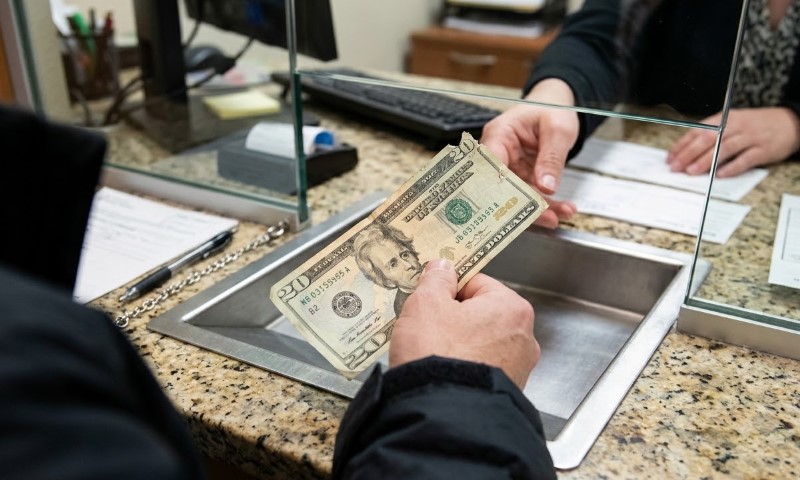
Imagine a $20 bill catches on a zipper and tears along its edge. Both pieces are available, its security features are visible, and nobody seriously doubts its denomination.
Taking it to a bank is the sensible first move.
Commercial financial institutions can exchange ordinary damaged bills and eventually send eligible unfit currency into the Federal Reserve’s processing system.
As a result, a bank can remove an unsuitable note without eliminating its monetary value.
However, banks aren’t automatically obligated to exchange every questionable bill presented at the counter. Internal procedures, account requirements, and concerns about authenticity can affect a branch’s decision.
Calling ahead is particularly sensible if you don’t have an account at the institution.
A cashier may not want your torn $20. Fortunately, the banking system has a way to retire it without retiring its value.
The Missing Half Is Where Things Get Complicated
Losing a corner is inconvenient. Losing half the bill introduces an entirely different problem.
Once 50% or less of the original note survives, ordinary bank processing generally isn’t the appropriate route.
Severe fire damage, flooding, chemical exposure, and animal damage can create similar problems even when a substantial portion of a bill survives.
Federal examiners at the Bureau of Engraving and Printing evaluate mutilated currency to establish its identity, value, and eligibility for redemption.
Such cases aren’t particularly rare.
On average, the BEP receives more than 22,000 examination requests annually, representing an estimated value exceeding $35 million.
An ordinary $20 bill might therefore end up in the same federal process used to evaluate thousands of dollars recovered after a disaster.
And having a fragment of genuine currency isn’t necessarily enough to receive payment.
Yes, the Treasury Might Replace Less Than Half a Bill
Here’s the exception that makes damaged-currency rules more interesting than a simple 50% cutoff.
BEP redemption standards allow full-value payment under two principal conditions:
- Clearly more than 50% of an identifiable U.S. note survives, including sufficient portions of relevant security features.
- Half or less survives, but the damage and supporting evidence satisfy examiners that the missing portion was completely destroyed.
Consider an illustrative situation involving a $100 bill damaged in a fire.
Only $40 worth of paper doesn’t exist as a meaningful measurement, of course. A surviving fragment covering 40% of the original note may still qualify for redemption if investigators determine that the other 60% was destroyed.
Conversely, someone presenting 40% of an ordinary bill without convincing evidence about the missing portion may receive nothing.
Why such caution?
Because two separate fragments of the same $100 bill shouldn’t each produce a $100 payment.
Treasury examiners must establish that the missing material cannot support another claim. Fraudulent submissions, material misrepresentations, and fragments that cannot be identified as U.S. currency may be denied.
Ultimately, the BEP director has final authority over redemption decisions.
How to Get a Damaged Bill Replaced Without Making Things Worse
View this post on Instagram
Repairing a bill might sound helpful. Depending on its condition, that instinct can make an already difficult examination harder.
For a Simple Tear, Try a Commercial Bank
Keep the bill and any detached pieces together.
Take them to your bank or credit union and ask about exchanging damaged currency. A teller can assess its condition and determine if the institution can accept it.
For an otherwise recognizable bill with a minor tear, submitting a federal claim would ordinarily be unnecessary.
For Severe Damage, Follow the Treasury’s Instructions
More serious cases require careful handling.
Follow these steps:
- Visit the official BEP mutilated-currency submission page.
- Complete BEP Form 5283, then print and sign it.
- Include an explanation of the damage and the requested claim information.
- Package fragile notes according to the agency’s instructions.
- Submit the completed form and damaged currency using the current mailing, shipping, or in-person delivery procedures.
Washington, D.C., is the only location accepting in-person BEP deliveries.
Importantly, fragile currency shouldn’t be taped, glued, flattened, laminated, or otherwise altered. Burned fragments may need to be packed exactly as found.
Currency damaged inside a container should generally be left there when practical.
Current BEP instructions also specify electronic redemption payments, so accurate banking information is important. Incorrect or missing payment details can delay an otherwise valid claim.
One additional detail: consumers shouldn’t mail mutilated currency directly to the Federal Reserve.
The Exchange Is Free. The Waiting Is Another Matter.
Exchanging an ordinary torn $20 at a bank may be a relatively straightforward transaction.
Federal examination operates on a different timetable.
According to Atlas Obscura, standard mutilated-currency requests can generally take six to 36 months to complete, depending on the condition of the notes, case complexity, and examiner workload.
For a single $20 bill, that creates an interesting practical calculation.
| 6-month processing | $3.33 per month |
| 18-month processing | $1.11 per month |
| 36-month processing | $0.56 per month |
Monthly equivalents are simple arithmetic, not payments or interest earned. Actual redemption, if approved, is based on the currency’s determined value.
BEP examination is free, although postage and packaging may cost money.
For someone recovering substantial cash after a fire, waiting for examination could be financially worthwhile. For one badly damaged $20, the administrative effort and possible mailing expense deserve consideration.
Money doesn’t stop being valuable just because its recovery becomes inconvenient.
Still, waiting three years to recover $20 isn’t quite the same experience as finding a forgotten bill in a coat pocket.
What Happens to the Damaged Bills Banks Take Back?
Once a bank accepts a worn or damaged note, its physical story may be nearly finished.
Commercial banks send eligible currency deposits to Federal Reserve facilities, where specialized equipment counts, sorts, and inspects notes.
Bills considered unsuitable for circulation are removed. At the St. Louis Federal Reserve, retired notes are shredded, with the resulting material recycled or composted.
During 2024, the St. Louis Fed inspected more than 949 million notes.
That enormous figure offers some perspective on the machinery behind an apparently simple bank exchange.
Currency also has a surprisingly varied working life. Federal Reserve estimates published in May 2025 put the average lifespan of a $20 bill at approximately 11.1 years, compared with 5.8 years for a $5 bill and 24 years for a $100 bill.
Frequently handled bills tend to wear out sooner. Currency kept primarily as savings experiences less physical stress.
Eventually, even perfectly genuine money becomes too battered to circulate.
Fortunately, shredding an unfit bill doesn’t mean its value has been canceled. Federal Reserve currency operations replace worn notes as part of maintaining usable cash.
The Next Time a Cashier Rejects Your $20, Check What’s Left of It
A rejected $20 bill doesn’t necessarily represent a $20 loss.
If most of it survives and its identity is clear, contacting your bank is usually the practical solution. Serious damage may require Treasury examination, supporting evidence, and considerable patience.
Before trying to repair a badly damaged note, resist the temptation to make it look presentable. Preserving what survives may matter much more.
A cashier refusing torn money can feel like the end of a transaction.
Sometimes, it’s simply the beginning of a surprisingly elaborate government process involving an ordinary piece of paper that still happens to be worth $20.