
Somewhere in your kitchen, a jar of pennies may be sitting untouched. Nobody particularly wants to count them, and spending them feels like more trouble than they’re worth. Meanwhile, American retailers are struggling to find enough pennies to make change.
America hasn’t run out of pennies.
According to the U.S. Treasury, roughly 114 billion pennies still exist, even though the government stopped producing new ones in 2025.
Your forgotten coins are still legal tender, still worth one cent each, and potentially more useful than they’ve been in years.
Apparently, having billions of something doesn’t guarantee anyone can find it when needed.
The Government Stopped Making Pennies Because They Cost Too Much
View this post on Instagram
Making a penny had become an expensive exercise in producing almost nothing.
By late 2025, manufacturing a single one-cent coin cost the federal government approximately 3.69 cents. A decade earlier, production had cost just 1.3 cents per coin.
According to the Treasury’s December 2025 figures, those expenses included raw materials, manufacturing facilities, and overhead. Every newly produced penny carried a manufacturing cost considerably greater than its face value.
Put another way, producing $1 worth of pennies cost approximately $3.69.
Federal officials eventually decided that arrangement wasn’t particularly economical.
Ending production is expected to generate approximately $56 million in immediate annual savings on materials alone, with additional savings possible as manufacturing operations adjust.
Inflation also helped make the penny increasingly impractical. A single cent buys very little today, while credit cards, debit cards, and digital wallets have reduced the number of transactions requiring physical change.
Under federal law, the Treasury Secretary has authority to determine how many pennies need to be minted to meet the country’s commercial needs.
Officials used that authority to suspend production rather than wait for the denomination to disappear through legislation.
One important distinction often gets lost in the headlines.
Stopping production isn’t the same as eliminating a currency.
Congress hasn’t abolished the penny, and existing coins haven’t lost their monetary value.
Government officials simply decided to stop spending nearly four cents to manufacture something worth one.
There Are 114 Billion Pennies. So Where Did They Go?
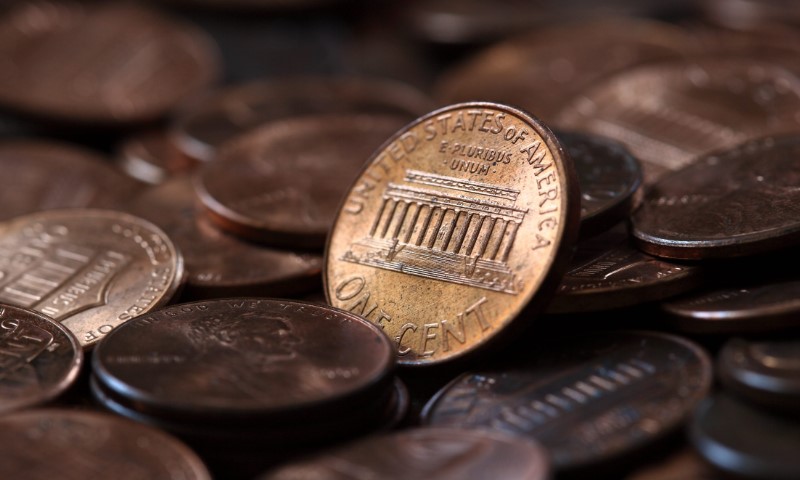
Finding enough pennies should hardly be difficult in a country containing approximately 114 billion of them.
Except that counting every penny in existence tells us remarkably little about where those coins are actually located.
Millions of Americans keep loose change in kitchen jars, dresser drawers, old purses, and car compartments. Pennies are particularly likely to accumulate because their purchasing power rarely justifies the inconvenience of counting them.
A jar containing 500 pennies holds only $5. That’s real money, but not necessarily enough to motivate a special trip to the bank.
Multiply that behavior across millions of households, and an enormous quantity of currency can sit outside everyday commerce.
Cashless payments make matters worse.
Businesses consequently receive fewer pennies that they can later distribute as change.
Another problem develops inside the banking system.
Banks ordinarily obtain coins through a distribution network connected to the Federal Reserve. Specialized coin terminals allow financial institutions to deposit excess coins and withdraw denominations they need.
But some terminals have stopped handling pennies, according to Byline Bank. Federal Reserve distribution centers in certain locations have also stopped fulfilling penny orders as inventories shrink.
Consider a neighborhood grocery store that needs $50 in pennies to prepare its registers for the week.
Ordinarily, its bank could provide 5,000 pennies through established coin distribution channels. If the local terminal no longer handles that denomination and the bank has exhausted its inventory, obtaining those coins becomes considerably harder.
Meanwhile, customers living a few blocks away may collectively have thousands of pennies sitting unused at home.
Nobody has misplaced the national supply. Available inventory simply isn’t reaching the businesses that need it.
With production suspended, the Federal Reserve must increasingly rely on existing pennies returning to circulation.
And unlike a mint, it cannot manufacture another batch when customers decide their coin jars are permanent furniture.
Your Pennies Are Still Legal Tender, but Stores Don’t Always Have to Accept Them

Finding an old penny in your pocket doesn’t mean you’ve discovered an obsolete piece of currency.
Existing pennies retain their full monetary value indefinitely.
You can still spend them at businesses willing or required to accept them, deposit them at participating financial institutions, and use them alongside other U.S. coins.
Federal Reserve banks will also continue recirculating existing pennies for as long as practical.
But there’s a legal complication.
Legal tender status doesn’t automatically require every private business to accept every form of cash in every transaction.
Federal law recognizes pennies as valid U.S. currency. It generally doesn’t force private retailers to accept particular coins for ordinary purchases.
Businesses may establish payment policies, subject to applicable state and local laws. Some jurisdictions impose additional cash-acceptance requirements that can limit a retailer’s ability to refuse physical currency.
Consequently, a store declining a handful of pennies isn’t necessarily violating federal law, although local rules could change that answer.
Treasury guidance encourages retailers to continue accepting pennies and providing penny change while supplies permit.
Completely eliminating the denomination would be a separate policy decision requiring further federal action.
For now, a penny minted decades ago has the same face value as one produced in 2025.
Its manufacturing date hasn’t changed its status as money.
The Penny Shortage Could Change What You Pay at Checkout
Imagine buying groceries with a final total of $9.98.
You hand the cashier a $10 bill.
Normally, you’d receive two pennies in change. But if the register contains no pennies, completing that transaction becomes unexpectedly complicated.
One solution is rounding cash payments to the nearest five cents.
Under the Treasury’s recommended approach, the $9.98 purchase would become $10.00, while a $9.97 purchase would become $9.95.
Here’s how the recommended rounding works for ordinary cash totals.
| Final cents in transaction | Recommended adjustment |
| Ending in 1¢ or 2¢ | Round down to 0¢ |
| Ending in 3¢ or 4¢ | Round up to 5¢ |
| Ending in 6¢ or 7¢ | Round down to 5¢ |
| Ending in 8¢ or 9¢ | Round up to the next 10¢ |
| Ending in 0¢ or 5¢ | No adjustment |
A particular exception concerns transactions totaling just one or two cents. Guidance acknowledges that those exceptionally small payments may need different treatment.
For ordinary purchases, the adjustment is limited to two cents in either direction.
An important detail concerns sales taxes.
Treasury recommendations call for taxes, fees, and other charges to be calculated first. Only the final cash payment should be rounded. State and local tax requirements still control how taxes are calculated.
Card payments, checks, gift cards, and other non-cash transactions generally continue using exact cent amounts.
In other words, a $9.98 purchase can still cost precisely $9.98 when paid electronically.
The Penny Isn’t Worthless. It’s Just Harder to Find Where It Matters.
America’s penny problem isn’t really about a shortage of metal discs bearing Lincoln’s face.
It’s about circulation.
Roughly 114 billion pennies were estimated to exist when the Treasury explained its production decision in December 2025. Many are still available for spending, but countless others have effectively retired into household storage.
Manufacturing has stopped, yet the coins retain their value indefinitely. Banks and retailers must now make better use of the existing supply while payment systems adjust.
For consumers, the practical consequences are fairly modest. Cash purchases may be rounded, bank coin-deposit rules may require a little preparation, and pennies can still be useful when businesses accept them.
No urgent trip to the bank is necessary.
Still, that forgotten jar deserves another look.
America has spent decades treating pennies as barely worth keeping track of. Now businesses are discovering how inconvenient it can be when everyone agrees.
The penny may be on its way out of the cash register. The ones in your kitchen drawer, however, haven’t received the memo.