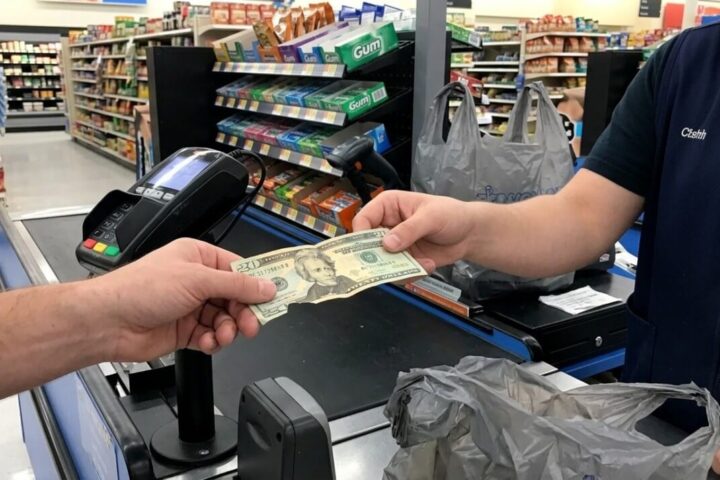
You buy something for $12.98, hand the cashier a $20 bill, and get exactly $7 back.
Two cents have disappeared. Nobody seems particularly concerned.
Depending on the state, that cashier may have followed a perfectly legal rounding rule. Around 20 states have now enacted laws addressing cash payments that don’t add up neatly to a nickel, although some provisions haven’t taken effect yet.
America stopped producing circulating pennies in 2025, and businesses are increasingly finding themselves short of the coins needed to make exact change.
So a purchase can now have two legitimate totals, depending on how you pay.
Which raises a small but rather interesting question. Who gets to keep those two cents?
The Penny Isn’t Gone. America Just Stopped Making More.

November 12, 2025, marked the end of an unusually long relationship. After 232 years, the U.S. Mint struck its final circulating penny in Philadelphia.
The video below shows that final penny being struck, marking the end of a 232-year chapter in American coinage.
Producing and distributing a single penny cost approximately 3.7 cents in fiscal 2024. Every new one-cent coin was costing taxpayers nearly four times its face value.
Stopping production made financial sense. Actually getting rid of the penny is another matter.
An estimated 300 billion pennies still exist, and every one already issued is still legal tender. Americans can continue spending them, businesses can continue accepting them, and stores can still price merchandise at $4.99. Apparently, ending a coin’s production is considerably easier than convincing people to empty their change jars.
Many pennies are sitting in homes, collections, and forgotten containers instead of circulating through banks and cash registers. Retailers consequently struggle to obtain the coins needed to make change, despite their enormous numbers.
America hasn’t run out of pennies. It has a problem getting them back into circulation.
Meanwhile, Congress has been working on the Common Cents Act, which also addresses the cost of producing nickels. Its provisions would permit testing cheaper materials for the five-cent coin.
Apparently, making money can be an expensive business.
How the Nickel-Rounding Rule Actually Works
Fortunately, calculating a rounded cash payment doesn’t require much mathematical enthusiasm.
Under standard nearest-nickel rounding, only the final purchase amount changes. Individual prices stay intact, and sales tax gets calculated before the adjustment.
Here’s how a $10 purchase total would work with different amounts of change.
| Original Cash Total | Rounded Cash Total |
| $10.01 or $10.02 | $10.00 |
| $10.03 or $10.04 | $10.05 |
| $10.06 or $10.07 | $10.05 |
| $10.08 or $10.09 | $10.10 |
Nobody gains or loses more than two cents per transaction under ordinary nearest-nickel rounding.
A $12.98 purchase becomes $13.00, while a $12.97 purchase becomes $12.95. Over repeated purchases, the adjustments can go in either direction.
Some rules also permit businesses to round down in the customer’s favor, even when ordinary rounding would increase the total.
Here’s the important distinction. Cash rounding doesn’t automatically apply to card payments, checks, or electronic transfers. Those transactions generally retain their original amounts.
Nor does ending penny production automatically require every American business to adopt rounding.
Nickels haven’t suddenly acquired additional purchasing power. Cash registers have simply acquired permission, under certain rules, to stop counting quite so precisely.
About 20 States Have Rounding Laws. The Rules Aren’t Identical.
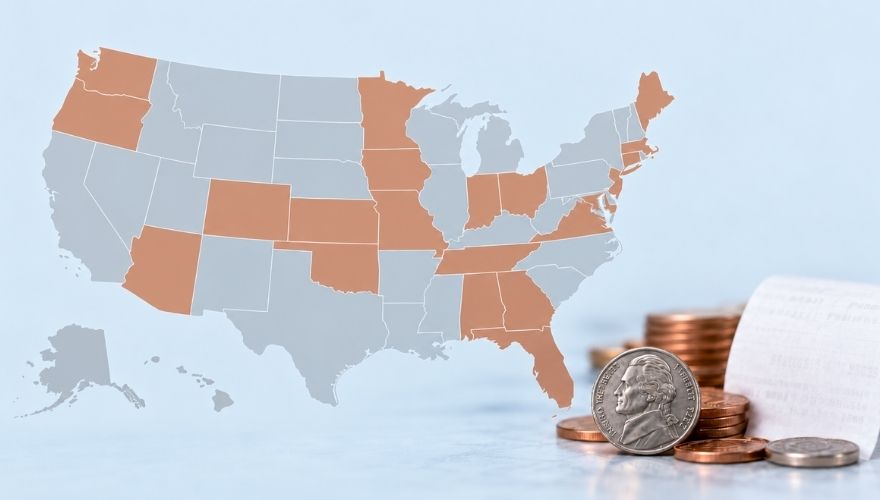
America has managed to turn a five-cent calculation into a state-by-state legal question.
By August 2026, 16 states already had cash-rounding laws in effect, according to a legal review. Additional measures have since taken effect or been enacted, bringing the total to roughly 20 states.
Some laws authorize rounding when pennies aren’t available. Others require businesses to follow a specified method. A few address government payments rather than ordinary retail purchases.
Consider three examples:
| State | Cash Rounding Rule | Effective Date |
| Arizona | Nearest-nickel rounding with mandatory notice. | Already in effect |
| Connecticut | Permits rounding while addressing cash-price discrimination. | January 1, 2027 |
| Oklahoma | Rounding for certain government cash payments. | November 1, 2026 |
Washington and Oregon have also addressed conflicts between cash rounding and other consumer protection requirements.
And that’s where the apparently harmless two-cent adjustment becomes legally interesting. Some jurisdictions prohibit retailers from charging cash customers a higher price than customers using other payment methods.
Suppose a $12.98 purchase costs $13.00 in cash but exactly $12.98 by card. Ordinary rounding explains the difference. A cash-price discrimination rule, however, can raise questions about that extra charge.
Connecticut regulators previously advised businesses to round down rather than charge cash customers more.
Connecticut and Oregon subsequently amended relevant laws to accommodate cash rounding.
Congress has also tried to simplify matters.
A federal Common Cents Act passed the House on September 14 and the Senate on September 28, 2026. As of the latest verified status, it was awaiting presidential action.
If enacted, the legislation would establish federal protections for qualifying cash rounding when exact change is unavailable, while permitting customer-favorable adjustments and addressing conflicting requirements.
For now, a small transaction can still depend on a surprisingly large collection of state and local rules.
The Two Cents May Change. Your Sales Tax Doesn’t.
Here’s something tax departments would rather businesses didn’t misunderstand.
Rounding a cash payment generally doesn’t change the sales tax owed on the purchase. Tax calculations still use the original amount, even when a different amount of cash changes hands.
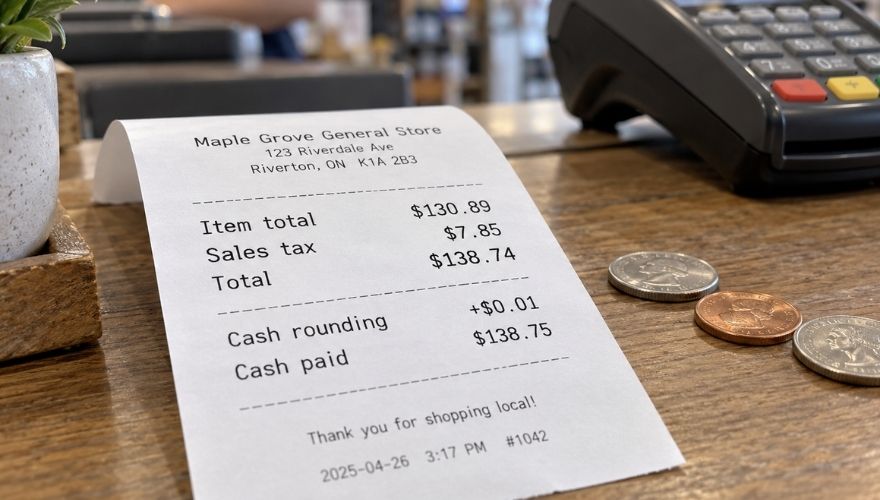
South Carolina’s 2026 guidance offers a particularly neat example.
A customer purchases an item costing $130.89. Sales tax adds $7.85, producing a final total of $138.74.
Under ordinary nearest-nickel rounding, the cash payment becomes $138.75. But the retailer still owes $7.85 in sales tax.
That extra penny doesn’t magically become taxable merchandise. Businesses must account for rounding adjustments separately, according to applicable requirements.
Certain states, including New Jersey and Washington, may also treat gains produced by rounding as income for specified tax purposes.
And cash isn’t necessarily the more expensive payment method.
Some smaller merchants have increasingly introduced credit card surcharges, meaning a customer paying electronically could face an additional fee even though their purchase total isn’t rounded.
A two-cent cash adjustment might be considerably cheaper than a percentage-based card surcharge.
Naturally, the sales tax department continues to care about every cent, even after the cashier has stopped.
What to Check the Next Time You Pay Cash
Nobody needs to conduct a legal investigation every time a cashier hands over change.
Still, a few details can tell you if a store’s rounding policy deserves a second look.
| What to Check | What to Look For |
| Rounding adjustment | No more than two cents up or down. |
| Posted notice | Store policy displayed where required. |
| Upward rounding | Totals shouldn’t always round up. |
| Individual prices | Rounding applies to the final total, not each item. |
| Payment methods | Compare cash adjustments with card surcharges. |
Pennies are still legal tender, although that doesn’t necessarily settle every question about a merchant’s obligations to accept them or provide exact change.
If a store’s policy seems unusual, asking how it works is reasonable. State consumer protection agencies can also clarify applicable requirements.
America may have stopped making pennies, but it hasn’t finished making rules about them.
A coin worth one cent now sits at the center of questions involving cash prices, tax calculations, federal legislation, and consumer protection.
Two cents may not be worth arguing over. But it’s worth knowing who’s allowed to keep them.