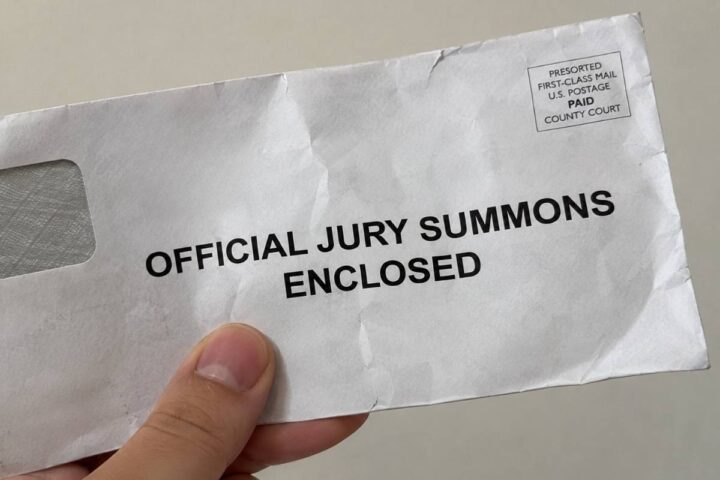
You come home after a vacation, sort through the mail, and find a jury summons. Your court date was last Tuesday.
Which raises an uncomfortable question: Can you actually get arrested for forgetting jury duty?
Technically, yes. But a missed summons doesn’t usually send someone straight to jail.
Jury duty isn’t an invitation, even if the envelope looks remarkably ordinary.
And what happens next depends heavily on what you do after discovering your mistake.
Missing Once Isn’t Usually the Biggest Problem

A first missed appearance may result in a warning, a failure-to-appear notice, or instructions to contact the jury office.
Some courts issue an order to show cause, requiring you to explain your absence to a judge.
Ignore those instructions, and the situation can become considerably less pleasant.
Depending on the jurisdiction, continued or deliberate noncompliance can lead to fines, contempt proceedings, or even a bench warrant authorizing an arrest.
A juror who fails to provide a good reason for ignoring a summons can face one or a combination of several fines:
- A fine of up to $1,000
- Three days in jail
- Community service
Not exactly the punishment most people expect to find hiding inside an ordinary envelope.
But these are possible penalties, not an automatic sentence for forgetting a date.
Here’s the distinction people often miss:
Forgetting your original summons and deliberately ignoring subsequent court orders can carry very different consequences.
Why Does the Court Care About Your Tuesday?
A jury summons looks like another government appointment, but it has a rather important job.
Courts need enough eligible people to assemble impartial juries. When prospective jurors don’t appear, jury selection becomes more difficult, and trials can face delays.
Getting summoned doesn’t automatically mean you’ll sit on a jury. You’re being called to participate in the selection process, where only some people will actually be chosen.
Nobody at the courthouse is particularly interested in ruining your Tuesday. They do, however, need enough people to show up so somebody else’s trial can happen.
A Phone Call Can Prevent a Much Bigger Problem
Fortunately, addressing a missed summons often begins with something considerably less dramatic than appearing before a judge: calling the jury office.
Contact the court promptly using the phone number listed on its official website. Explain what happened, even if the explanation is simply that you forgot.
Travel, illness, or misplaced mail may help explain your absence. Keep relevant documentation in case the court requests it.
Ask if you can reschedule and if any additional action is required. Don’t assume everything has been resolved until the court confirms your status.
Oddly enough, the original mistake may be easier to explain than the decision to do nothing about it afterward.
A forgotten appointment is one thing. Ignoring official instructions once you’ve discovered the problem is quite another.
One Detail Can Change the Entire Outcome
Here’s where the obvious answer stops working: There isn’t one national rule determining what happens when someone misses jury duty.
Federal, state, and local courts have different procedures and penalties. Some may allow a straightforward rescheduling.
Others may require a formal explanation, particularly after repeated absences.
Courts can impose monetary sanctions of up to:
- $250 for a first violation
- $750 for a second
- $1,500 for a third.
Apparently, the paperwork can get considerably more expensive each time you decide not to answer it.
A legitimate excuse can help, but it doesn’t automatically cancel the obligation.
And if you’ve already received a contempt notice, court order, or warrant, requesting another jury date may not be enough. Follow the court’s instructions and consider speaking with an attorney.
Missing jury duty doesn’t automatically mean you’re headed to jail.
But a forgotten envelope can become a much bigger problem when every notice that follows joins the same pile.