
You walk into a store carrying an unopened holiday gift, its original packaging, and a receipt proving exactly where it was purchased.
Nothing is damaged. Nothing is missing. You simply don’t want it.
An employee checks the receipt, looks at the item, and refuses the return.
Surely they can’t do that?
Actually, they often can.
No general federal law requires American retailers to accept unwanted, nondefective merchandise simply because a customer has changed their mind. A receipt proves a purchase happened. It doesn’t automatically create a right to reverse it.
Holiday returns are hardly an unusual request. Retailers expected 17% of holiday sales to be returned in 2025, according to industry estimates.
That’s roughly one dollar in every six spent during the season potentially heading back through a return counter.
Apparently, handling millions of returns and being legally required to accept yours are two very different things.
But there’s a detail that can turn an ordinary disagreement at the return counter into a consumer protection issue.
The Store Gets to Make the Rules. Until It Has to Follow Them.
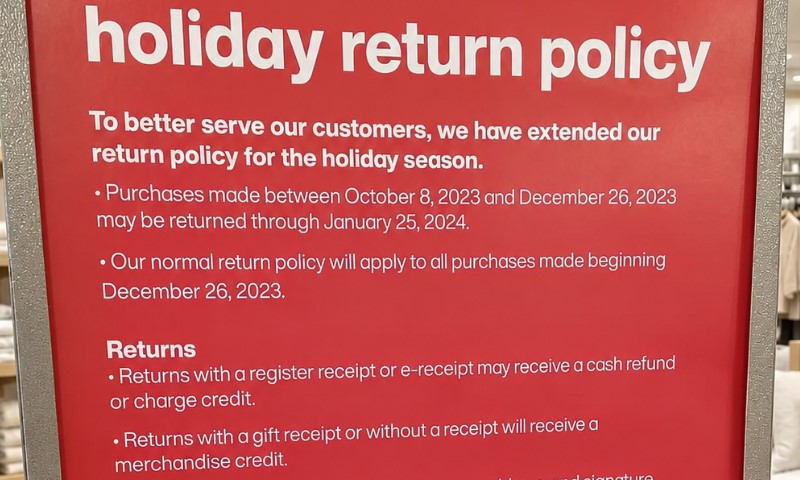
Retailers generally have considerable freedom to decide how returns work. One store might offer a full refund within 30 days.
Another might allow exchanges only. A third could refuse returns on clearance merchandise altogether.
None of those policies is necessarily illegal.
Problems begin when a retailer promises one thing and does another, or introduces restrictions that customers couldn’t reasonably discover before making their purchases.
New Jersey offers a particularly interesting example.
Under its refund-policy disclosure law, covered retailers with restrictive policies must clearly disclose their terms before a sale. Posting a policy near the register, at the entrance, or on the merchandise can satisfy applicable disclosure requirements.
Printing the restriction only on the receipt may be too late. And New Jersey gives that distinction some teeth.
A covered retailer that violates the disclosure law may have to provide a cash refund or credit, at the buyer’s option, for qualifying merchandise returned within 20 days of purchase, provided the goods haven’t been used or damaged by the buyer. Certain merchandise categories are excluded.
An exchange-only policy or restocking fee isn’t automatically unlawful, either. But imposing a previously undisclosed restriction can raise consumer protection concerns.
Violations involving New Jersey’s Consumer Fraud Act may also create exposure to triple damages and attorney’s fees when the applicable legal requirements are satisfied.
“All Sales Final” Doesn’t Always End the Conversation

Few retail phrases sound quite as decisive as “all sales final.”
For an unwanted gift, that notice may be enough to end the discussion. A sweater that doesn’t fit or a coffee maker someone already owns isn’t automatically the retailer’s responsibility.
But a defective coffee maker presents a different legal problem.
Consumer protection and warranty laws distinguish between merchandise a customer no longer wants and merchandise that doesn’t work as promised.
Several circumstances can create potential legal remedies:
| Issue | What It Means | Possible Consumer Rights |
| Defective merchandise | A product fails during normal use. | Repair, replacement, or another warranty remedy. |
| Incorrect merchandise | A customer receives a different item than ordered. | Replacement, refund, or another remedy under applicable law. |
| Mislabeled products | An item differs materially from its description or advertised features. | Potential warranty or consumer protection claims. |
| Express warranty violations | A product fails to meet specific promises about quality or performance. | Enforcement of applicable retailer or manufacturer warranties. |
An “all sales final” notice doesn’t automatically eliminate those protections. Still, discovering a defect doesn’t guarantee an immediate cash refund.
Applicable warranty terms and state law may allow a seller or manufacturer to attempt repairs or provide a replacement first.
One distinction matters more than almost anything printed on the return receipt.
Not liking a product and receiving a product that doesn’t work are legally different complaints.
Warranty protections can outlast the store’s ordinary return deadline. Implied warranties may last as long as four years in some states, even without a written warranty.
That doesn’t mean customers can demand a refund for any appliance that breaks four years after purchase. Coverage depends on state law and the nature of the problem.
But a 30-day return window and a product’s legal warranty protections aren’t necessarily the same thing. A retailer may have finished accepting unwanted merchandise long before every possible warranty obligation has expired.
The Deadline May Have Started Before You Opened the Gift
Christmas morning may be the first time you see your present.
Unfortunately, the store’s return clock might have been running for weeks.
Some retailers impose 30-day or 90-day return windows, commonly measured against the original purchase date rather than the date someone unwraps the gift.
Consider a present purchased on November 20 and opened on December 25. A standard 30-day return period would already have expired before the recipient even knew what was inside the box.
Holiday extensions sometimes solve that problem. Retailers may voluntarily offer longer deadlines for purchases made during November and December.
But those extensions aren’t universal, and the details matter.
A store might accept holiday returns through late January while excluding electronics, personalized merchandise, or final-sale products. Another might provide store credit instead of returning the original payment.
Gift receipts introduce another small complication.
They’re designed to conceal the purchase price while documenting the transaction, but they don’t necessarily entitle the recipient to cash. Depending on the retailer’s policy, an exchange or store credit may be the only option.
No receipt at all?
What to Do When the Store Refuses

An employee refusing a return doesn’t automatically mean the business has violated consumer protection law.
Before arguing, establish what the store actually promised and why your return was rejected.
A few practical steps can help separate an enforceable policy dispute from a disappointing but lawful refusal.
| Step | What to Do | Why It Matters |
| Check the return policy | Review store signs, receipts, and website terms for deadlines and exclusions. | Restrictions may need to be disclosed before purchase. |
| Gather evidence | Bring the item, receipt, original packaging, and ID if required. | Proof of purchase can help establish return eligibility. |
| Speak with a manager | Request a review of the refusal or an exception. | Managers may have authority to resolve disputes. |
| Document inconsistencies | Save screenshots, photos, and records of conflicting return terms. | Evidence can support a complaint about an advertised policy. |
| Escalate violations | Contact your state attorney general’s consumer protection office. | Misleading policies or disclosure violations may warrant investigation. |
Politeness is useful here, but documentation is better.
A manager might approve an exception simply to resolve a customer complaint. That doesn’t mean the exception was legally required.
Conversely, a retailer refusing to honor its advertised conditions may have a more serious problem than an unhappy customer.
One especially useful question is: “Where was that restriction disclosed when the item was purchased?”
An employee may have a perfectly reasonable answer. But if the restriction appeared only after payment, the answer could matter under applicable state law.
And if the original purchase was made weeks before Christmas, check the dates before spending an afternoon arguing about them.
Sometimes the store is following its policy exactly. Sometimes the policy itself is the problem.
Sometimes the Fine Print Works in Your Favor
Most unwanted holiday gifts are returned because retailers choose to accommodate customers, not because federal law requires them to accept every change of mind.
That distinction explains why two stores can treat identical merchandise very differently without either doing anything illegal.
But voluntary return policies aren’t necessarily empty promises.
State disclosure laws, advertised terms, and warranty protections can create obligations that a retailer cannot simply disregard.
A posted restriction might legally justify refusing a return. An undisclosed restriction might create a problem for the business instead.
And an item that is defective rather than merely unwanted brings an entirely different set of rules into play.
So before accepting that final refusal, take another look at the paperwork.