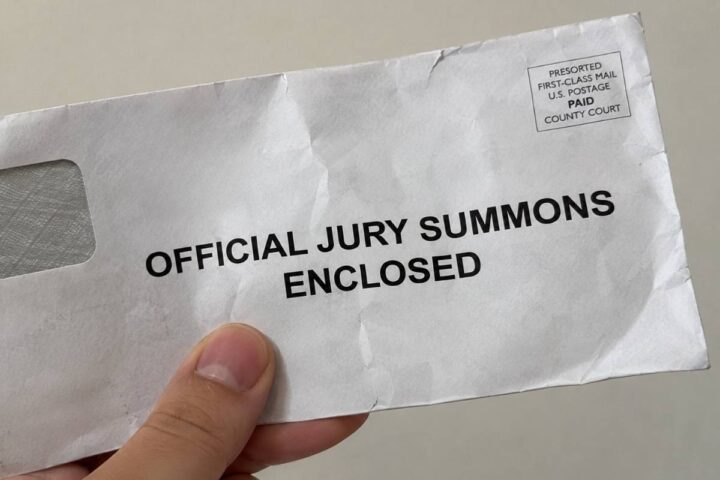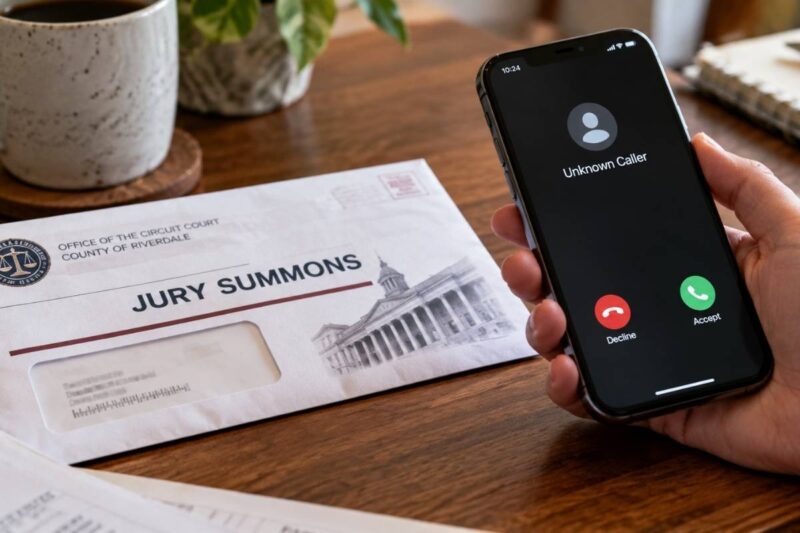
Someone claiming to be a sheriff’s deputy calls with troubling news. You missed jury duty, a judge has issued a warrant for your arrest, and officers could arrive at your home unless you settle the matter immediately.
Naturally, you have questions. For starters, when were you supposed to report for jury duty?
Unfortunately, the caller isn’t especially interested in that question. Payment, however, can apparently make the warrant disappear.
Here is the uncomfortable part.
Missing jury duty really can carry legal consequences, including fines, court appearances, and even arrest. Scammers have simply discovered that a genuine legal obligation makes an excellent foundation for an imaginary emergency.
On September 30, 2026, Chief Judge Marcia Morales Howard of the U.S. District Court for the Middle District of Florida warned that criminals were impersonating judges, court employees, and law enforcement officers to frighten people into paying money.
Actual penalties are possible. Instant telephone settlements are another matter entirely.
The Caller May Know More About You Than You Expect
A suspicious telephone call is easy to dismiss when the stranger on the other end barely knows your name.
Unfortunately, some jury duty scammers have done their homework.
Public records and other readily available information can provide personal details, real judges’ names, and enough background to make a fictional legal problem sound remarkably convincing.
Some callers go further. In Florida, Judge Howard described several techniques that criminals use to manufacture an appearance of official authority:
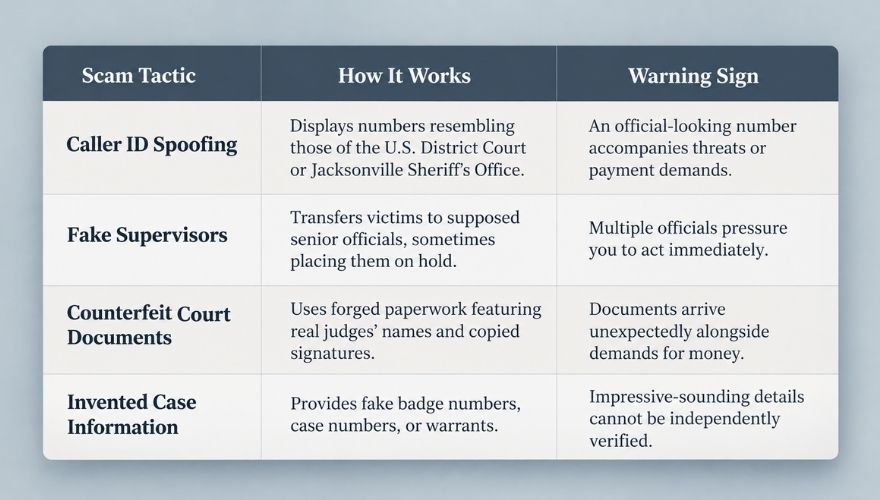
None of these details proves that a caller works for a court.
That reaction explains something important about the entire operation.
Scammers don’t necessarily need you to believe an elaborate story. Sometimes they only need to frighten you before you’ve had an opportunity to examine it.
An official-sounding voice announces a serious problem. Your mind starts considering the consequences.
By the time payment enters the conversation, you’re already trying to escape a situation that never existed.
Missing Jury Duty Can Have Consequences. Just Not Like This.
Ignoring a legitimate jury summons isn’t a clever way to avoid civic responsibility.
Depending on the court and circumstances, failing to report can result in a fine, a required court appearance, or even an arrest. Judges have legal authority to address people who disregard jury obligations.
But an absence doesn’t automatically establish that an arrest warrant exists, much less create a fine that must be paid before the next commercial break.
Judge Howard explained how the federal court process works in the Middle District of Florida.
Someone who misses jury duty receives a letter delivered through the U.S. Postal Service, not a threatening telephone call or text message demanding immediate payment.
Before being required to pay a penalty for failing to appear, that person gets an opportunity to appear in court and explain the absence.
Legal terminology has a name for that protection: due process.
Perhaps you never received the original summons. Maybe an unexpected medical problem prevented you from attending. Courts have procedures for examining circumstances like these.
Specific rules and penalties differ among federal, state, and local courts. Still, an unexpected demand for immediate payment over the telephone isn’t how a legitimate court resolves missed jury service.
Notice the difference.
Hang Up. Then Call the Court Yourself.

A convincing caller may have your address, know your full name, and recite the name of a judge who actually works at your local courthouse.
You still don’t owe that person a conversation.
If an unexpected caller threatens arrest over missed jury duty and demands immediate payment, end the call. No argument is necessary, and there is little benefit in trying to catch the person contradicting themselves.
Next, verify the situation independently.
A few precautions can keep a frightening telephone call from becoming an expensive mistake:
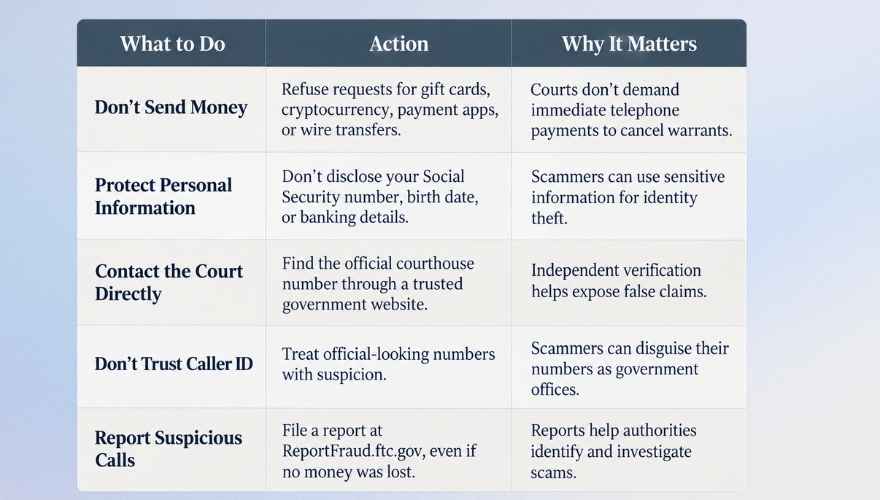
For federal jury-related questions in the Middle District of Florida, Judge Howard’s court provided 904-549-1900 as a verification number.
People who have already sent money should immediately contact the bank, payment app, wire transfer provider, or other service involved and ask about reversing the transaction.
Anyone who disclosed sensitive identifying information can also visit IdentityTheft.gov for help determining the appropriate next steps.
One distinction deserves particular attention.
Hanging up on a suspicious caller doesn’t mean you can ignore a genuine jury summons or an official notice that arrives later. If you’re concerned about missed service, contact the appropriate court directly and resolve the matter through its established procedures.
A legitimate obligation doesn’t disappear because somebody used it as material for a scam.
The Jefferson County Sheriff’s Office has also warned the public about similar jury duty scams, urging people to alert family and friends.
A Real Courthouse Will Still Be There When You Call Back
Jury duty scams borrow their credibility through a peculiar combination of truth and fiction.
Courts really can penalize people who neglect jury service. Judges really do issue warrants. Missing an important government notice can create complications.
Scammers take those possibilities and add something that doesn’t belong: a stranger demanding immediate payment to prevent your arrest.
An authentic judge’s name, a convincing caller ID, and an official-looking document cannot establish that a warrant actually exists.
And there is no reason to let the person making the accusation control how you verify it.
A caller may know your name, your address, and the name of a real judge. None of that proves there’s a warrant.
If there really is a problem with your jury service, the courthouse will still be there after you hang up.