
A jury summons arrives in the mail. You check the reporting date, look at your work schedule, and realize a routine legal obligation could interfere with your next paycheck.
Jury duty is mandatory for eligible citizens who are summoned, but regular wages aren’t always guaranteed.
Federal courts generally pay jurors $50 per day, an amount that may fall considerably short of their usual earnings.
So, do you get paid for jury duty when a court requires your attendance?
Answers depend on the court, your state’s employment laws, and your company’s leave policy.
n some cases, employees receive their regular wages. In others, performing a civic responsibility comes with a financial cost.
Federal Courts Pay $50 a Day, but There’s a Catch

Federal courts generally pay jurors $50 for each day of service. Trial jurors who complete 10 days may receive up to $60 daily afterward if the presiding judge authorizes an increase.
Grand jurors can also qualify for the higher $60 rate, although eligibility begins after 45 days of service.
Federal jury duty pay follows a relatively straightforward system, but its limitations become obvious when court compensation is compared with an employee’s regular earnings.
According to the U.S. Courts’ official juror payment guidelines, federal courts generally pay jurors $50 for each day of service. Trial jurors who complete 10 days may receive up to $60 daily afterward if the presiding judge authorizes an increase.
Additional compensation may cover certain expenses, including:
- Reasonable transportation expenses associated with courthouse attendance.
- Parking fees at courts that authorize reimbursement.
- Meals and lodging when overnight stays are necessary.
Federal government employees generally receive their regular salaries instead of the standard federal juror attendance fee.
For private-sector employees, however, jury duty pay can be considerably lower than their usual earnings.
Consider someone earning $200 per workday. If that employee misses five working days for federal jury service and receives no wages during the absence, the financial difference becomes difficult to ignore.
| Compensation | Five working days |
| Regular earnings | $1,000 |
| Federal jury payments | $250 |
| Potential income shortfall | $750 |
A $150 daily shortfall may not seem dramatic until it becomes a $750 difference over one working week.
State courts establish their own compensation rates, so employees summoned for state jury duty may receive different amounts.
Court compensation pays for attendance. It doesn’t necessarily replace the wages someone sacrifices to attend.
Your Employer Must Let You Serve. Paying You Is Another Matter.

Federal law generally does not require private employers to pay employees for time spent on jury duty.
For employees asking do you get paid for jury duty if your boss approves the absence, the important detail is that permission to miss work does not automatically create an obligation to pay regular wages.
Under the Fair Labor Standards Act, employers typically aren’t required to compensate employees for time they do not work. Paid jury leave is generally determined by applicable state laws, employment agreements, or company policies.
Job protection is a different legal matter.
Federal law prohibits employers from firing, intimidating, or coercing permanent employees because of federal jury service. State laws provide additional protections for workers attending state or federal proceedings.
Consequently, a manager generally cannot legally punish a protected employee simply for complying with a jury summons.
Still, an employee can have a legally protected absence without receiving their normal paycheck.
Some companies voluntarily provide paid jury-duty leave, allowing employees to collect their regular wages for several days or throughout their service.
Paid jury leave isn’t guaranteed across American workplaces. Figures cited in a 2020 resolution by the Conference of Chief Justices indicated that approximately one-third of employers did not provide paid leave for jury service.
Job protection, in other words, has not always come with paycheck protection.
Others provide unpaid leave and expect employees to rely on court compensation.
A workplace may therefore comply with employment law while leaving an employee with less income that week.
The Rules Change Depending on Where You Work
State laws create considerable differences in jury duty pay.
Some jurisdictions require employers to compensate workers for a limited number of days. Others protect employees’ right to attend court without requiring continued wages.
State jury duty pay requirements can create significant differences in employee compensation, even when workers spend the same number of days attending court.
Three states show how differently the rules can operate.
New York – Up to $72 a Day for Three Days
New York generally requires employers with more than 10 employees to pay qualifying workers up to $72 per day for the first three days of jury service.
Employees earning less than $72 daily receive their applicable wages, with the state potentially covering the difference. Workers whose employers aren’t required to pay may receive the state’s $72 daily jury fee.
New York increased its jury fee to $72 on June 9, 2025, replacing the previous $40 rate.
Even with that requirement, a worker normally earning $200 daily could experience a substantial reduction in income.
You can watch Kyle Newman’s video for more information about New York jury duty rules and exemptions.
Massachusetts – Regular Wages for the First Three Days
Massachusetts generally requires employers to pay regularly employed jurors their usual wages for the first three days of qualifying jury service.
Coverage can include full-time, part-time, temporary, and casual employees, subject to applicable employment conditions.
After the third day, eligible jurors may receive $50 daily through the state. Employers can voluntarily continue paying regular wages for longer periods.
Certain workers, including some independent contractors and self-employed individuals, face different compensation rules.
Colorado – Employer Payments Capped at $50
Colorado requires employers to compensate regularly employed jurors during their first three days of service.
Required payments generally equal regular wages, capped at $50 daily unless the employer agrees to pay more.
Qualifying employment can include part-time, temporary, and casual work when established scheduling requirements are satisfied.
After the third day, jurors generally receive $50 per day through the state. Special provisions also address financial hardship.
California – Jury Pay Increased to $100 Before Funding Cuts Ended the Program
California briefly experimented with considerably higher compensation.
Seven trial courts participated in a program that increased jury payments from $15 to $100 daily, only for funding cuts to suspend the initiative in 2025.
Participating courts returned to the standard $15 rate, demonstrating how quickly a juror’s expected compensation can change when funding disappears.
You can watch this video to learn more about California’s proposal to increase jury duty pay to $100 per day.
Salaried Employees Have an Additional Federal Protection
Employee classification creates another important distinction.
For salaried employees wondering whether they get paid for jury duty during a regular workweek, federal salary-basis protections can make a substantial difference.
Under federal salary-basis rules, qualifying exempt salaried employees generally must receive their full salary for any workweek in which they perform work, even if jury service occupies part of that week.
Employers generally cannot reduce those employees’ salaries because of jury-duty absences during such a workweek, although they may offset qualifying jury fees. An entirely missed workweek with no work performed can be treated differently.
Hourly employees generally do not receive that same federal salary-basis protection.
Two people sitting on the same jury can therefore return home with very different paychecks, even after spending identical hours in court.
Can Your Boss Make You Use Vacation Days for Jury Duty?
An employee planning a summer vacation probably doesn’t expect a jury summons to consume part of their paid time off.
Yet some employers require workers to use accrued vacation days or other paid leave during jury service.
Access to paid time off isn’t universal, either. Federal labor statistics published in August 2026 found that 71% of wage and salary workers had access to paid leave in 2024-2025.
That figure covers leave generally, not jury duty specifically, but it helps explain why using vacation days isn’t necessarily an option for every employee.
Legality depends on state law, applicable employment agreements, and workplace policies. Certain states restrict mandatory use of accrued leave for jury duty.
Company rules can also determine how court payments interact with regular wages.
Company jury duty pay policies should also explain how paid leave interacts with vacation balances, particularly when employees receive separate compensation through the court.
For example, an employer that continues paying an employee’s salary may require the employee to surrender the jury attendance fee or deduct that fee against the wages provided, where permitted.
Federal salary-basis rules expressly allow qualifying jury-fee offsets for exempt employees.
Expense reimbursements are another matter. Transportation, parking, and lodging payments are intended to cover eligible costs associated with attendance rather than provide additional wages.
Before reporting to court, employees should establish three things: how many days their employer will pay, how any PTO requirement operates, and how jury compensation affects their paycheck.
An employee who assumes that protected leave automatically means paid leave could discover the difference only after reviewing a pay stub.
What to Check Before Jury Duty Costs You Money
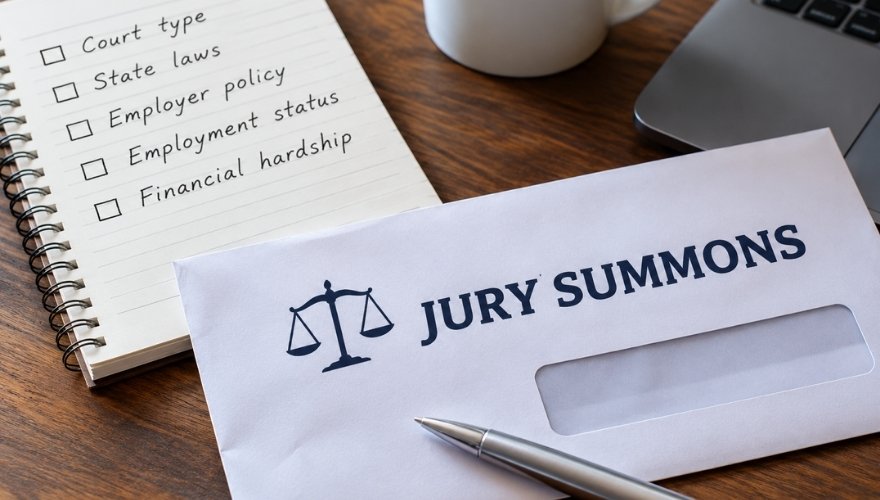
A jury summons provides reporting instructions, but it may not explain how the absence affects employment income.
Asking whether you get paid for jury duty before the reporting date gives employees time to identify potential income losses and discuss available options with their employers.
Several checks can prevent an unexpected financial problem:
| What to Check | What to Know | What to Do |
| Court type | Federal and state payment rates differ. | Check your summons and court rates. |
| State laws | Paid leave and worker protections vary. | Review state requirements. |
| Employer policy | Wages, court fees, and PTO rules differ. | Confirm payment terms with HR. |
| Employment status | Compensation rights depend on classification. | Check your eligibility for paid leave. |
| Financial hardship | Courts may grant postponement or excusal. | Contact the court and request approval. |
Employees should also retain their summons and obtain proof of attendance if their employer requests documentation.
A financial hardship request is particularly important for workers who cannot afford an extended interruption in earnings.
Waiting until the reporting date can limit available options.
The Civic Duty Is Mandatory. The Paycheck May Not Be.
Jury duty occupies an unusual position in American working life. Citizens can be legally required to attend court, but employers aren’t universally required to replace the wages they lose.
Federal jurors generally receive $50 per day, with limited opportunities for higher compensation during extended service. State regulations and workplace policies determine what additional financial protection employees may receive.
Ultimately, jury duty pay can depend as much on employment classification and state regulations as it does on the number of days spent in court.
For some workers, jury duty means a normal paycheck and a temporary change of workplace. For others, it means accepting considerably less income while fulfilling the same legal responsibility.
Knowing the applicable rules before reporting can help employees plan their finances, discuss compensation with their employers, and avoid unexpected deductions.
The summons tells you when to appear. It doesn’t necessarily tell you what that day will cost.